
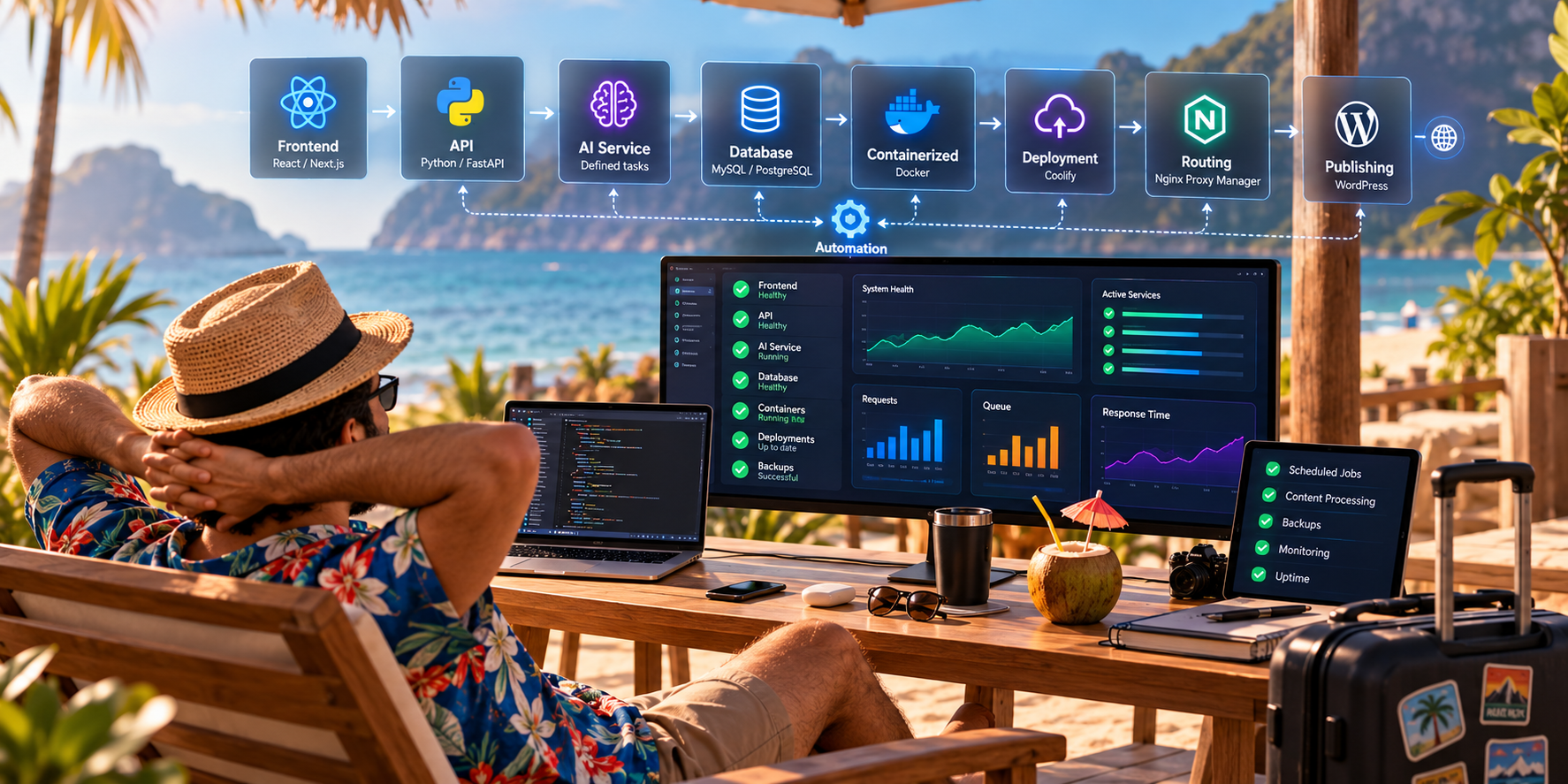
My Favorite Architecture Test: Can I Take a Vacation?
I have a simple test for any system I build: if I take a week off, can someone else keep it running without calling me?
It sounds like a question about documentation. Really, it is a question about architecture. If deploying a change requires remembering three undocumented commands, or finding the one person who knows which database belongs to which site, the system is not finished.
I work as a senior architect and AI developer, and I enjoy the space between writing software and making it dependable. Python is often where I start: a FastAPI service can turn an idea into a clear workflow, whether that means processing a submission, talking to an AI model or retrying a job when another service is unavailable. JavaScript and TypeScript bring that workflow to the people using it. With React and Next.js, I can make the complicated work behind the scenes feel straightforward on the screen.
Then comes the question every promising demo eventually faces: where does it live?
That is where Docker becomes one of my favourite tools. I use it to give an application a predictable home alongside the services it needs. MySQL or PostgreSQL holds the data. GitLab tracks the code. Coolify helps run deployments. Nginx Proxy Manager, the NPM I mean when I talk about routing, connects the right domain to the right service. None of these tools is particularly magical on its own. The interesting work is making their responsibilities clear.
I have spent enough time with WordPress projects to know that “the site is backed up” can mean several very different things. Do we have the files? The database? The uploads? Can we actually start the site and reach it through a domain if the original host fails? Those questions are far more useful than a green status badge.
AI systems deserve the same scrutiny. I love using AI to remove tedious work, but I prefer giving it a well-defined role. If an employee writes an article, AI might create the short description that appears on its card. It should not quietly rewrite their story. Around that small AI task, the application still needs authentication, sensible upload limits, a queue for failures and a way to tell the author what happened.
That balance is what makes the work fun for me. One day I am shaping a React page so a teammate can publish without opening a CMS. The next I am working through a Python API, a Docker network or a database recovery path. Each decision should make the next person’s job easier.
I want the people I work with to have the freedom to make changes, understand the result and recover when something goes wrong. If they can do all that while I am on vacation, I know I have built something worthwhile.